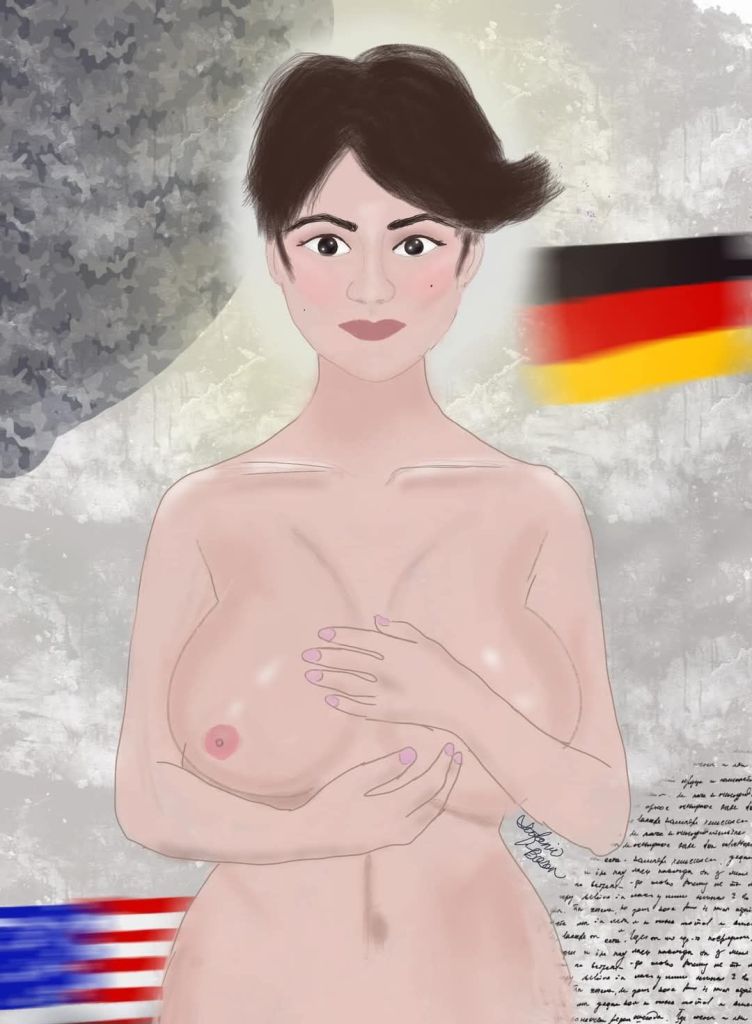
I was born from ruin, from hunger,
a child of sorrow stitched from the remnants of history,
woven together with the thread of survival.
From the bones of a world broken and reformed,
I rose, carrying the weight of two broken pasts
and the hope of something that could heal the cracks between them.
A body made from ghosts,
an echo of two lands torn by war.
This is the inheritance I carry,
the ashes and the earth,
the fire and the dust,
the blood that runs deeper than any border drawn.
My mother was a girl with shoes too small,
hand me downs that never quite fit her, a life lived in borrowed skin.
Her feet twisted and disfigured by shoes
that were never meant for her, the pain of them a reminder
that her life would never be her own,
that she would always wear the scars of others’ choices.
She learned early to carry the weight of the world on her shoulders,
to walk with grace, even as the world crushed her beneath its feet.
Her heart, heavy with the burden of survival,
never truly found rest,
but still, she held it together,
fought her battles,
and loved beyond what the world ever deserved.
And Oma ran with my mother in her arms,
a mother fleeing through the ashes of her home,
her heart pounding with every step, the bombs falling from the sky like the wrath of a world gone mad.
In the midst of that chaos,
Oma held her child close,
the only thing that mattered in a world that had lost its meaning.
She ran, her feet a blur,
the smoke and fire swallowing the world behind them,
her heart broken but unyielding.
She ran because it was all she could do,
because survival wasn’t a choice,
but a fight,
a fight she couldn’t afford to lose.
The bombs tore through the night,
the sound of destruction, a constant companion,
but Oma, she held on,
clutching my mother to her chest as if love itself could shield them from the storm.
And when they reached the edge of safety,
when the fire had passed and the sky cleared,
Oma had nothing left but her love,
her sacrifice,
and the bitter knowledge that even safety was fragile,
that the world they had known was gone,
and in its place was a land that would never forget
the war that had torn everything apart.
My mother, still a child,
grew up with the weight of a past she could never outrun,
a past that followed her wherever she went.
She came here,
to this new world,
to this land that promised freedom,
but found only judgment.
She married my father,
her future intertwined with his own roots,
deep in the heart of a country that would never see her as its own.
She arrived here as an adult,
still carrying the scars of a broken land,
the echoes of war in her heart,
but now she had to wear a new armor:
a foreign accent,
a face that carried the mark of a history
that wasn’t hers to claim.
And they called her a Nazi.
They looked at her and saw nothing but the weight of a war
she had never fought in,
but was forever bound to.
Her accent, her voice,
carried the weight of a thousand mistakes
that she had no part in.
The world she entered was cold,
a place where she was made to feel like an outsider,
a second-class citizen,
treated with suspicion and scorn
because of where she had come from.
She endured the stares,
the whispered words,
the shuddering looks that followed her
as though her very presence were a reminder
of a war she could never escape.
She became invisible in her visibility,
a woman who carried the sins of a generation
that would never let her forget.
She was forced to endure medical tests,
to prove her innocence,
to show that she was not her past,
not her father’s war,
not her country’s mistakes.
And still, no one saw her for who she was, a mother, a daughter, a woman who had survived
only to be rejected by the world that should have embraced her.
And Opa, my mother’s father,
a man whose soul had been scarred by a war
he could never outrun.
He was taken from his home,
marched into the hell of Stalingrad,
a prisoner of war,
his body and mind tortured
by the brutality of human cruelty.
He watched men die before him,
their blood staining the earth,
their lives slipping away like sand through fingers.
He saw the darkness of war,
the hunger, the madness, the devastation,
and he became a prisoner of it,
locked away in the haunted silence of his own mind.
His hands trembled with the weight of things
he could never forget.
He carried with him the faces of the dead,
the cries of the fallen,
the cold of Stalingrad,
the heat of a battle that would never let him go.
The war left him marked,
not just in his body,
but in the very marrow of his bones.
He couldn’t speak of it,
he couldn’t even look at it,
but it was always there,
always whispering in his mind,
a constant reminder of the brutality of mankind,
the hell that could be unleashed
when the world fell apart.
And my father,
my father, born into the poverty of the Deep South,
a boy whose world was made of hunger,
whose body was too thin to hold the weight of his dreams.
He was malnourished,
his body a reflection of the life he was forced to live,
scrambling for scraps where others had abundance.
He spoke with a stutter,
his words tangled in his throat,
as though even his voice was too weak
to fight its way out.
But he learned to survive,
to fight for every breath,
to scrape through life with the same determination
that had been passed down to him
by a mother who struggled with her own mind
and a father who taught him to be tough,
no matter the cost.
His voice was slow, hesitant,
but his will was iron,
and he carved his way through a world that was never kind
with nothing but grit and resolve.
And I,
I was the child of them both,
the inheritance of their survival,
the sum of their scars.
I have walked through the remnants of their lives,
traced the paths they carved through darkness,
felt the weight of their burdens settle into my own bones.
I carry their stories in my blood,
their silence in my heart,
and their strength in my veins.
But my mother,
my mother died,
believing that God was punishing her
for a past she never chose,
for the country she was born into,
for the war that had ravaged her soul.
She carried the guilt of a generation,
the weight of history that never let her go.
And in the end,
she believed that the God who was meant to heal her
was the same God who turned his face away,
judging her for things she could never change.
She died believing she was condemned,
trapped in a world that would never release her,
a prisoner of her own survival.
But I,
I carry her love,
I carry her heart,
and though she could never see the worth in herself,
I will see it for her.
I will carry her broken pieces and make them whole,
because she was more than the past she lived,
more than the judgments of the world.
And I will carry that truth
to places she could never go.
I am the child of a war that never really ended,
a bridge between worlds that were never meant to meet,
a living testament to the struggle of those who survived.
But still, I rise,
not as ruin, not as hunger,
but as the proof that something can grow
from the wreckage of war and want.
From the ashes and the earth,
from the blood and the fire,
something holy can be born.
I carry my mother’s love,
my father’s strength,
Oma’s courage,
Opa’s silence,
and from that inheritance,
I will build something new.
Not from the pain,
but from the power that came from surviving it.
And though the world will always remember
the shadows of our past,
I will stand in the light of what we have become.

 The Dreamer's Pen
Leave a comment